
Marketplace for
Scripophily collectors
Choose your language
Wählen Sie Ihre Sprache



|
|||||||||
 |
|||||||||
Item Number |
34 | ||||||||
Name |
Oriental Bank Corporation | ||||||||
Location(s) |
|||||||||
Country |
Indien, Hong Kong, Großbritannien | ||||||||
Region |
Asien | ||||||||
Description |
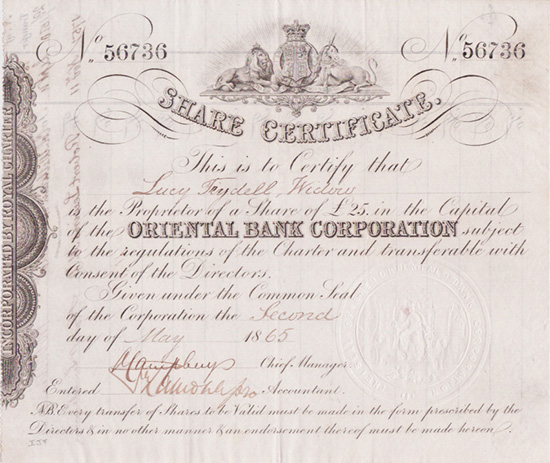
02.05.1865, 1 Share of £25, #56736, Vignette mit Wappen, Löwen und Einhorn, Blindprägesiegel, Schätzpreis: 100 €. | ||||||||
Description (English) |
2 May 1865, 1 Share of £25, #56736, vignette with coat of arms, lion and unicorn, seal, estimate: € 100. | ||||||||
Condition |
VF+ | ||||||||
|
|||||||||
 |
|||||||||
|
|||||||||
History (German) |
Die Bank of Western India wurde 1842 in Bombay gegründet und verlegte 1845 ihren Hauptsitz nach London. Nach Eröffnung von Filialen in Colombo (1843), Kalkutta (1844), Shanghai (1845), Kanton (1845), Singapur (1846) und Hongkong (1846) wurde 1850 die angeschlagene Bank of Ceylon übernommen. Infolge der Fusion änderte sich der Name 1851 in Oriental Bank Corporation. Danach durfte die Bank in den Wettbewerb gegen das Opiumhandelsmonopol der East India Company treten. Weitere Filialen wurden in Mauritius, Madras (Chennai), Thalassery, Melbourne, Sydney, Auckland, Wellington, Port Elizabeth, Durban, Fuzhou (Foochow), Yokohama, Hiogo (Kobe) und San Francisco eröffnet. In den 1860er Jahren hatte die Bank eine dominante Stellung in Indien und China inne und galt als "mächtigste, älteste und angesehenste ostasiatische Wechselbank". Als Wechselbank war sie die erste Bank in Hongkong und die erste Bank, die in Hongkong Banknoten ausgab. Trotz all dieser Erfolge litt die Bank in den 1870er Jahren unter schweren Verlusten durch schlechte Kredite, was 1884 zur Zahlungseinstellung und schließlich 1892 zur Liquidation führte. | ||||||||
History (English) |
Established as Bank of Western India in Bombay, India, in 1842, its headquarters were moved to London in 1845. After opening branches in Colombo (1843), Calcutta (1844), Shanghai (1845), Canton (1845), Singapore (1846) and Hong Kong (1846), the failing Bank of Ceylon was taken over in 1850. As a consequence of this merger, the name changed to Oriental Bank Corporation in 1851. Since then the bank was allowed to compete with the East India Company's opium billing monopoly. Additional branches opened in Mauritius, Madras (Chennai), Thalassery, Melbourne, Sydney, Auckland, Wellington, Port Elizabeth, Durban, Fuzhou (Foochow), Yokohama, Hiogo (Kobe) and San Francisco. In the 1860s, the bank held a dominant position in India and China and was considered the "most powerful, oldest and most prestigious Eastern exchange bank". As an exchange bank it was the first bank in Hong Kong and the first bank to issue banknotes in Hong Kong. Despite all these successes, the bank faced severe losses from bad loans in the 1870s, leading to a suspension of payment in 1884 and final liquidation in 1892. | ||||||||
|
|||||||||
Please have a look at our highlight items: |
|||||||||
|
|||||||||
Stay connected
Bleiben Sie in Verbindung